Simulation needs authority
A proposed action needs a policy boundary and an accountable decision-maker, not only a predicted outcome.

TrustOps is being extended into governed digital twins. Our R&D explores how policy, simulation, human authority and evidence can govern increasingly autonomous cyber-physical operations.
Research direction, not a product. Not a separate product. Not currently offered as a production capability.

Industrial operations are becoming more automated and more model-driven at the same time. A digital twin can simulate what an action would do before it happens — but simulation on its own does not answer who authorised the action, which policy applied, or what evidence remains afterwards.
A proposed action needs a policy boundary and an accountable decision-maker, not only a predicted outcome.
The more a system can act on physical operations, the more important it is to define where a human stays in the loop.
Cyber-physical decisions should leave a record that can be reviewed after the fact, in the same way AI-assisted workflows do today.
The research extends the TrustOps loop with a simulation stage and an explicit governance stage: Observe → Simulate → Decide → Govern → Act → Prove.
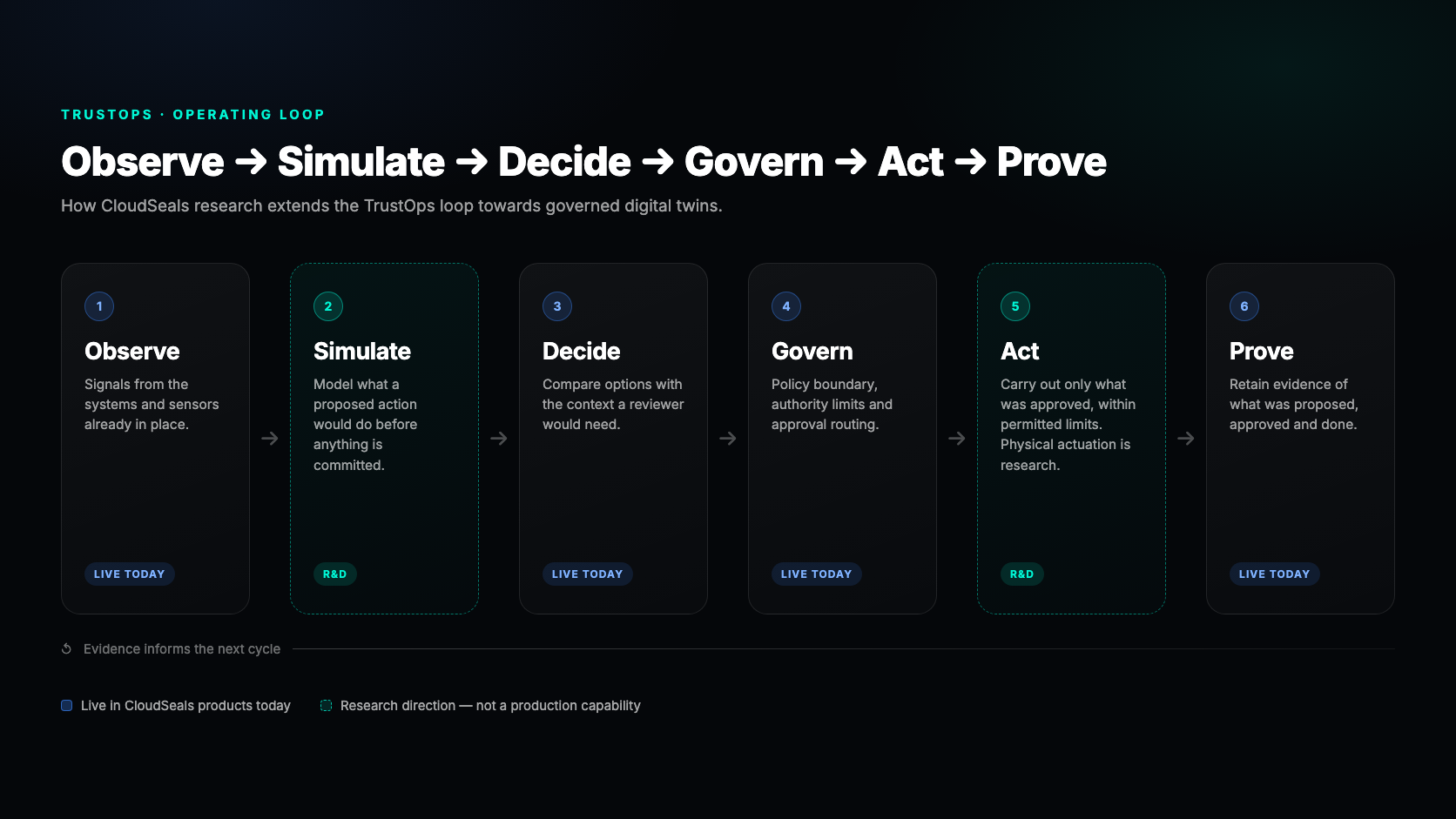
Connect operational signals from the systems and sensors already in place.
Model what a proposed change or action would do before anything is committed. R&D.
Compare options with the operational context that a reviewer would need.
Apply the policy boundary, authority limits and approval routing that TrustOps defines today.
Carry out only what was approved, within permitted limits. R&D for physical actuation.
Retain the evidence of what was proposed, approved, done and observed afterwards.

Governed digital twins are a research direction that builds on what CloudSeals already runs in production. TrustOps is the operating discipline and Evidence Fabric is the shared evidence layer used by LedgerSight, CompliSight and CarbonSight today.