Source context
System, file, sensor, ledger or workflow source used by the AI-supported process.

Evidence Fabric is the shared evidence layer across CloudSeals applications. It records source context, model/agent details, purpose, policy/authority context, outcomes, approvals/overrides, downstream actions and final results.
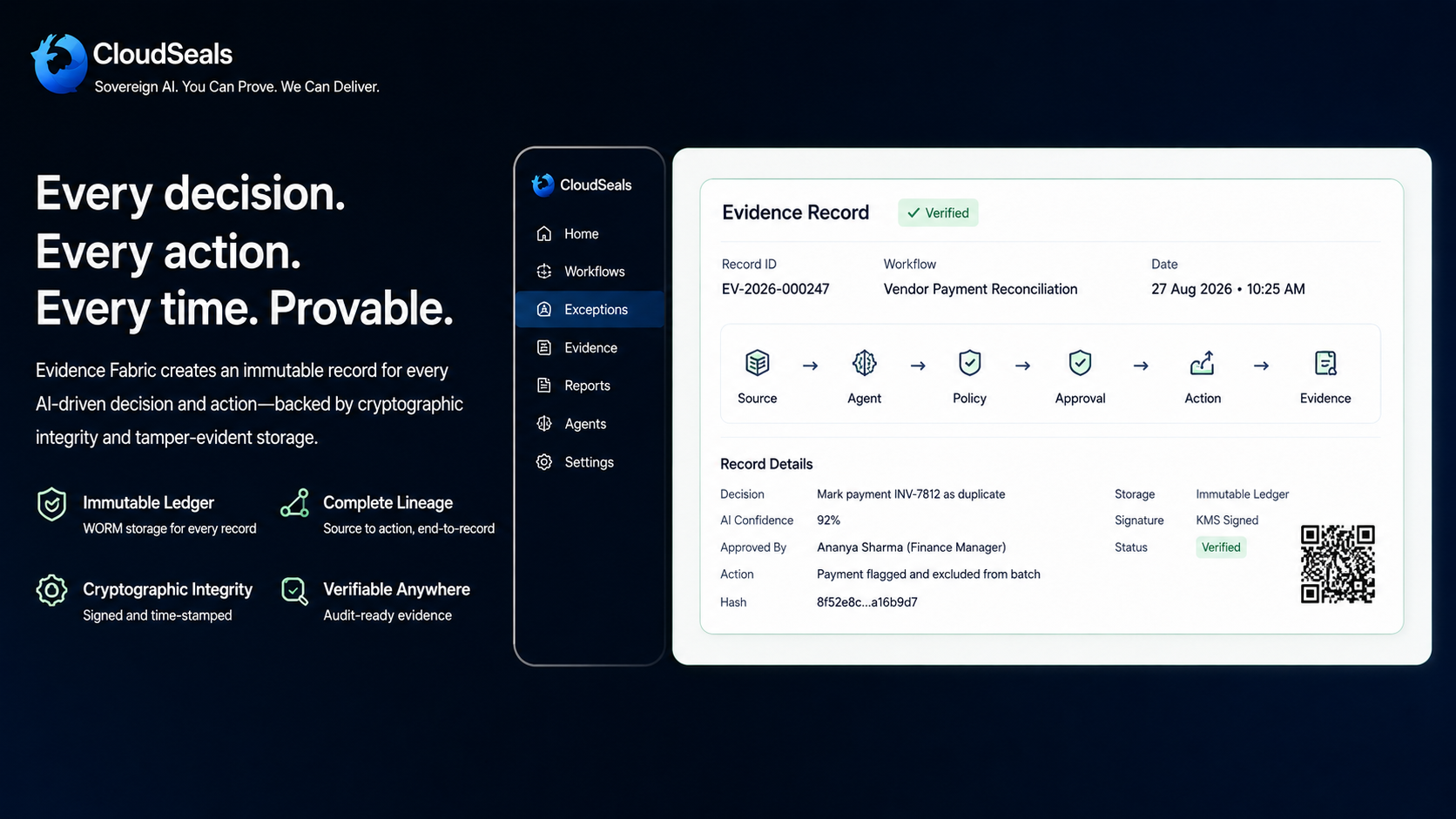
System, file, sensor, ledger or workflow source used by the AI-supported process.
Applicable rule, operating procedure, approval threshold or regulatory reference.
Reviewer, approval status, exception reason and final action separated from AI recommendation.
Which model or agent produced the recommendation, so a reviewer knows what they are looking at.
What the AI-supported step was for — the reconciliation, the safety rule, the carbon figure.
Who was entitled to approve, and the limits that applied to them.
What the AI proposed, what the person decided, and any override with its reason.
What was carried out after approval and what the final result was.
A configured decision per deployment, not a fixed default, because reporting and audit obligations differ by organisation and jurisdiction. See Security.
Controlled through identity and access management; use of the record is itself recorded.
Records are readable in the application and exported where the workflow needs it — for example, CarbonSight exports evidence for assurance and reporting.
Written for someone who was not there: an internal reviewer, an auditor or a regulator can follow what happened and on what basis.
Evidence Fabric is used by the reviewers who make decisions in LedgerSight, CompliSight and CarbonSight, and read by the auditors and regulators who check them. It is not purchased separately: it comes with each application, and the deployment model is agreed per engagement. It is the evidence layer of what CloudSeals calls an accountable AI platform.
Evidence Fabric connects source information, policy context, human review and workflow outcomes in a reviewable record.
CloudSeals research is extending TrustOps and Evidence Fabric into governed digital twins — how policy, simulation, human authority and evidence could govern increasingly autonomous cyber-physical operations.
Research direction, not a product. Not a separate product. Not currently offered as a production capability.
If each application keeps its own notes, an auditor has to reconcile three stories. A shared evidence layer means a finance exception, a safety alert and a carbon figure are all recorded the same way — same fields, same shape, one place to look.
Source, purpose, policy context, decision and outcome are recorded the same way across applications.
The record is produced by the workflow, not assembled afterwards from memory.
The point is that someone who was not there can follow what happened.
Worth stating plainly, because evidence claims attract scrutiny.
It is the shared layer underneath LedgerSight, CompliSight and CarbonSight.
It records what happened. Whether that satisfies a given regulation is a judgement made by your auditors and regulators.
It records the decision context around the systems you already run.
Evidence Fabric is the shared evidence layer across CloudSeals applications. It records source context, model/agent details, purpose, policy/authority context, outcomes, approvals/overrides, downstream actions and final results.
Source context, model and agent details, the purpose of the action, the policy and authority context that applied, the outcome, approvals and overrides, downstream actions and final results.
No. It is the shared layer beneath the CloudSeals applications rather than a separate product.
It gives a reviewer what they need to follow a decision. Whether that meets a particular obligation is decided by your auditors and regulators, not by the software.
Someone who was not in the room — an internal reviewer, an auditor, a regulator — reading it after the fact.
TrustOps is the operating discipline for accountable AI and requires that a record exists. Evidence Fabric is where that record lives.