1. Observe
Connect the signals from the systems already in place — ledgers, approved camera feeds, operational and sustainability data.

TrustOps is the operating discipline/category for accountable AI. CloudSeals applications implement it in real workflows; Evidence Fabric provides the shared evidence layer.
Article 4 AI literacy is a TrustOps use case. It is an operational governance/evidence use case, not a fourth CloudSeals product and not a certification of Article 4 compliance. Explore Article 4 AI literacy →
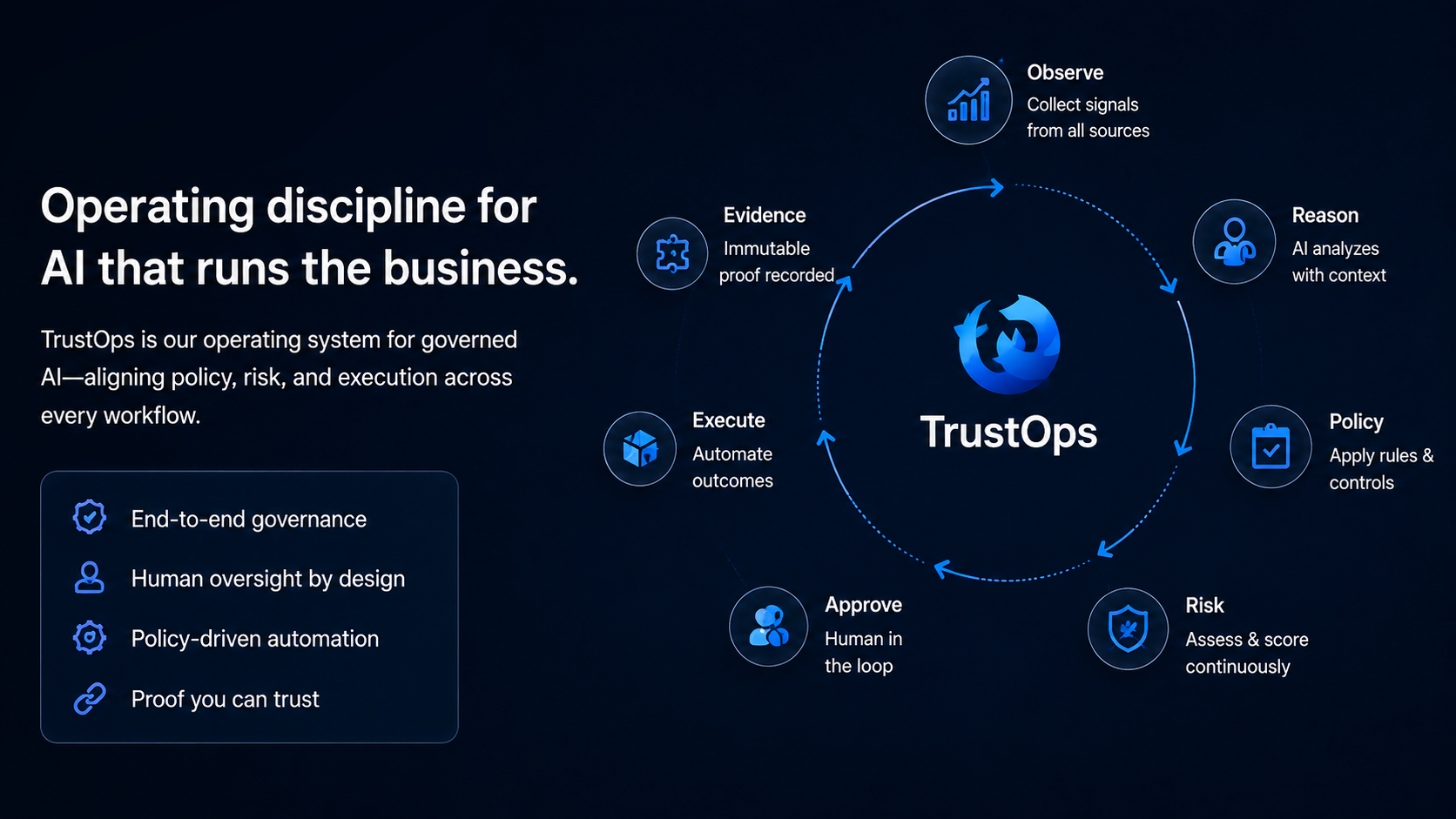
TrustOps organizes accountable AI work into repeatable stages: observe, reason, apply policy, assess risk, approve, execute and retain evidence.
Connect the signals from the systems already in place — ledgers, approved camera feeds, operational and sustainability data.
The application identifies exceptions and proposes a next action, with the context that explains why.
The boundary — rule, operating procedure, approval threshold or regulatory reference — is applied before anything happens, not argued about after.
The recommendation is placed in its operational context so the reviewer can see what is at stake.
A person who holds the authority reviews and approves, rejects or overrides. AI recommends; people and policy decide.
Only what was approved is carried out, within the permitted limits.
What was proposed, on what basis, who approved it and what followed are written to Evidence Fabric as the work happens.
Teams running AI-assisted work where a wrong answer has consequences: finance operations, industrial site safety and carbon reporting in regulated organisations. It is adopted by the people accountable for the workflow — finance reviewers, site supervisors, reporting and assurance teams — and it is implemented through the CloudSeals applications rather than bought on its own. Read what this means as an accountable AI platform.
Finance operations workflows where AI recommendations remain separate from approved business action.
Industrial safety workflows that support supervision, incident review and evidence retention.
Carbon MRV workflows that connect source data, calculations, review and reporting evidence.
Research is extending the loop into governed digital twins, adding a simulation stage and an explicit governance stage: Observe → Simulate → Decide → Govern → Act → Prove. Simulation and physical actuation are R&D, not current capabilities.
Most AI failures in regulated work are not model failures. The model answers; what is missing is the boundary it answered inside, the person who accepted it, and the record that survives afterwards. TrustOps names that missing part and makes it repeatable.
The boundary is set before the model runs, not argued about after.
Recommendations are reviewed and approved by someone who holds the authority to approve them.
What was proposed, on what basis, who approved it and what followed are all retained.
The category is easier to use when its edges are clear.
TrustOps is the operating discipline. LedgerSight, CompliSight and CarbonSight are the products that implement it.
It is how work is done, not a badge awarded by anyone.
It is how governance decisions show up in day-to-day operations.
No. TrustOps is the operating discipline. The products that implement it are LedgerSight for finance operations, CompliSight for industrial safety and CarbonSight for carbon MRV.
Governance decides what is allowed. TrustOps is how that decision reaches the workflow: the policy boundary applied at the moment of the decision, the human approval, and the evidence kept afterwards.
TrustOps organises accountable AI work into repeatable stages: observe, reason, apply policy, assess risk, approve, execute and retain evidence.
Evidence Fabric is the shared evidence layer across CloudSeals applications. TrustOps says a record must exist; Evidence Fabric is where that record lives.
The opposite. AI recommends; people and policy decide. The discipline exists to keep the approval and the accountability with a person.