

Money movement
Bank confirmations, lender files and loan ledgers do not always agree.
A governed lending operations framework for digital lenders and NBFCs: loan workflows, financial reconciliation, human authority and reviewable evidence in one chain, powered by LedgerSight under the TrustOps discipline.
Visual concept. Lending modules and integrations are scoped in discovery.
One connected workflowLoan events, money movement and the ledger in one financial-control chain.
Named human approvalConsequential actions wait for a person with the authority to approve them.
Decision evidenceSource, policy version, reviewer and outcome kept with the decision.
An application, approval or payout can look complete in the interface while the bank, the ledger and the lender’s own records tell different stories.
The opportunity is not another dashboard. It is a reviewable chain between the decision, the money movement and the person with authority.
Bank confirmations, lender files and loan ledgers do not always agree.
Outcomes may be stored without the source, reason and rule version behind them.
Maker-checker must be enforced, not treated as a status label.
Audit and lender review packs take time when records live in separate systems.
LedgerSight handles financial reconciliation. Planned lending workflow modules connect the lifecycle. TrustOps applies the agreed operating boundary, and Evidence Fabric retains the decision trail.
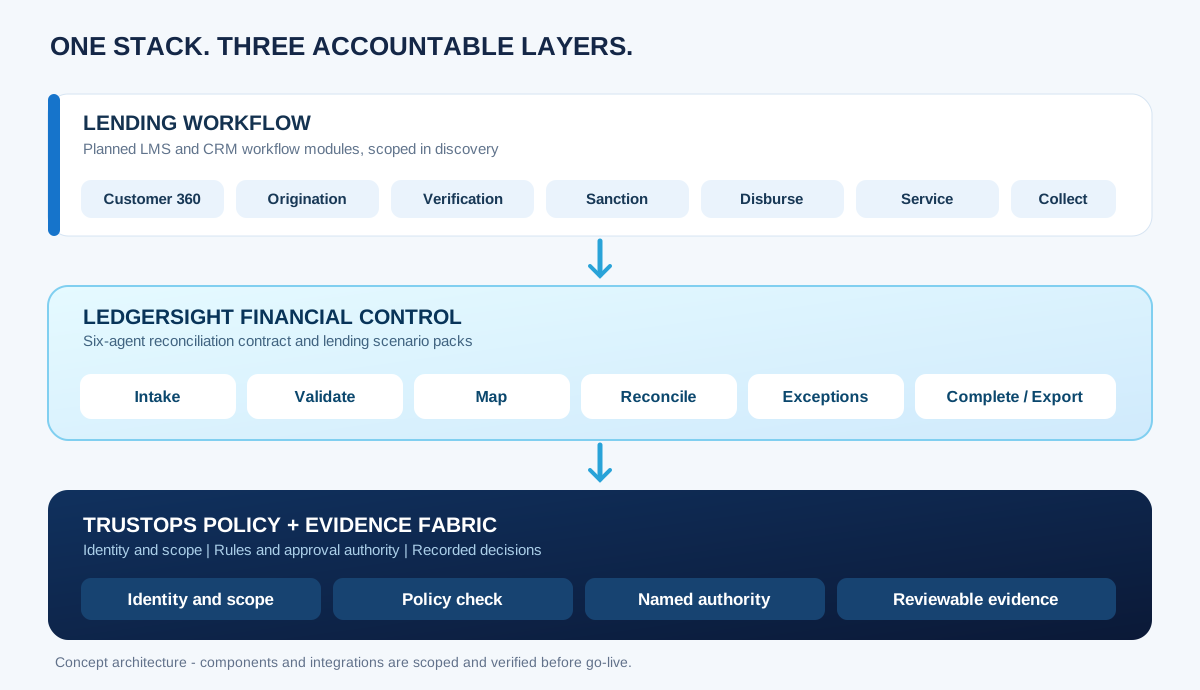
Customer 360, origination, servicing and collections are phased modules, scoped in discovery.
The reusable six-agent reconciliation workflow, configured for lender, bank and payment records.
The policy boundary and the shared decision record, not additional standalone products.
A target workflow for digital lenders and NBFCs. Every stage has an action owner and a policy boundary; the breadth of the LMS/CRM build is agreed in discovery.

Customer identity, records and verification tasks.
TrustOps: consent and permitted purpose.
Eligibility checks, reason codes and reviewer records.
TrustOps: policy version and named authority.
Instruction, bank reference, deductions and net movement.
TrustOps: maker-checker, no self-approval.
Receipts, instalments, adjustments and exceptions.
TrustOps: reviewed adjustments and reversals.
Balances, settlements, open exceptions and review packs.
TrustOps: closure and write-off authority.
A synthetic disbursement case. LedgerSight isolates the difference; TrustOps determines who may take the next action.
Unexplained variance₹1,000
Illustrative values. This page does not process money, connect to a bank or execute a live loan decision.
Sources, payout reference and the difference stay attached to the case.
The case is routed to the named finance approver.
An agent has no standing authority to change a balance.
Source references, rule version, reviewer and final outcome, as agreed for the deployment.
Configure the reusable LedgerSight matching pipeline around the records, keys and exception types the lender already uses.
Compare the approved sanction, allowed deductions and expected net payout against the actual bank confirmation. Isolate duplicate, short, failed or unmatched transfers.
Match bank receipts and payment-processor events to instalment schedules. Surface partial, late, reversed and unallocated receipts for lender review.
Compare platform loan-book movements with co-lender, NBFC or partner statements. Explain fees, timing breaks and ledger-to-settlement differences.
Verify final repayment and outstanding balance inputs before proposing closure. Flag unresolved adjustments, waivers or write-offs for authorised review.
Every consequential action passes through the lender’s configured boundary. These are example policies for a lending engagement, not a claim that a lender’s rulebook is already deployed.
A named reviewer may inspect records for the lender and portfolio they are permitted to access. That access is recorded.
A payout discrepancy above the configured tolerance goes to an authorised finance reviewer with the context attached.
Self-approval, cross-lender queries and unapproved data use are refused under the defined policy.
Evidence availability, signing, retention and independent verification are assessed and agreed for each deployment. TrustOps is an operating discipline, not a certification or a separate product. How TrustOps works · Evidence Fabric
We agree the measures before the pilot, inspect a representative record population and report what we find. No time-saving or reduction percentages are promised in advance.
Count and age of disbursements without a valid matching bank reference.
Elapsed time from a discrepancy being surfaced to a reviewed decision.
Share of selected cases with the agreed source, policy and reviewer record.
Repeated callbacks or references that cause posting anomalies.
A four-week, read-first reconciliation proof before any broader lending platform roadmap. Scope, data, price and timeline are confirmed with the lender.
Select one reconciliation case, data fields, policy owners and acceptance criteria.
Set file mappings, case keys, tolerances and reviewer roles in the approved scope.
Process test cases, surface exceptions and exercise the approval and denial routes.
Reconcile the outputs, review evidence completeness and agree next steps.
No. The solution reuses the existing LedgerSight finance reconciliation foundation. Customer 360, origination, sanction, servicing and collections modules form a phased lending build whose scope is confirmed during discovery.
No. Credit decisions, regulated lending, funds movement and customer obligations remain with the authorised lender and its approved systems. The first LedgerSight proof is read-first and keeps human authority.
The work can be scoped around lender records, loan ledgers, bank files and payment references. Every named API, KYC, bureau, LMS or bank connection is verified in the customer environment before it is described as operational.
LedgerSight is the CloudSeals finance operations application. TrustOps is the operating discipline applied to the workflow: policy boundaries, named human approval and decisions with retained evidence. Evidence Fabric is the shared record layer.
No. It supports configurable controls and records relevant to the engagement. The regulated lender remains responsible for its legal obligations, policies and regulatory interpretation. A security and compliance review is part of scoping.
LedgerSight workflow and boundaries · LedgerSight for finance teams · Security review · Evidence standards
Share a representative reconciliation challenge. We will discuss source systems, policy owners, data boundaries and a measurable first proof.