Bank reconciliation
Statement lines are matched against ledger entries so the differences — timing, duplicates, missing references — are what a person actually looks at.

LedgerSight connects finance and operational data, identifies exceptions, proposes next actions and keeps the evidence behind every important decision. It is designed for teams that want more automation without turning finance control into a black box.
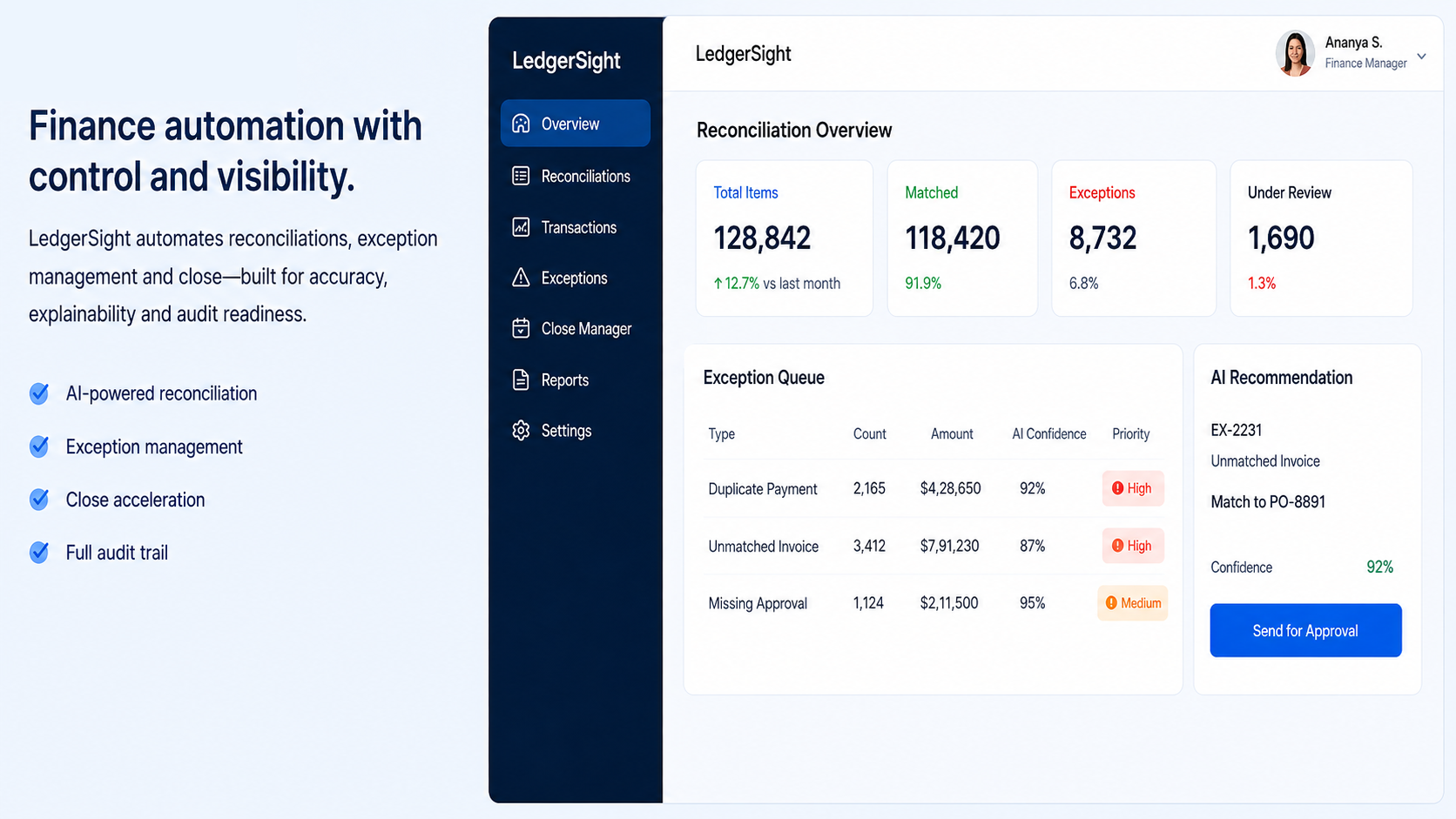
Statement lines are matched against ledger entries so the differences — timing, duplicates, missing references — are what a person actually looks at.
Customer receipts are lined up against open invoices, so unapplied cash and short payments surface as exceptions rather than being found later.
Supplier invoices that do not agree with the purchase order or receipt are routed for review with the context that explains why they were flagged.
Overdue accounts are ordered by what is worth chasing first, with the reasoning shown alongside the recommendation.
Incoming payments are proposed against the right invoices, and the proposal is reviewable before anything is applied.
Recurring close checks are gathered in one place so reviewers see status, open exceptions and what evidence exists for each.
Patterns behind repeated exceptions are surfaced, so the same break stops arriving every month unexplained.
Review AI recommendations, exception context and supporting evidence before an approved business action.
Reconciliation breaks that surface late, unapplied cash and short payments found after the fact, supplier invoices paid against the wrong order, and a close where nobody can say afterwards why an exception was handled the way it was. LedgerSight is for finance teams in regulated operations who want more automation without turning finance control into a black box.
Bank statement lines, ledger entries, customer receipts and open invoices, supplier invoices, purchase orders and receipts — from the finance and operational systems already in place.
Lines are matched; what does not agree — timing differences, duplicates, missing references, short payments, invoice-to-PO mismatches — becomes an exception with the context that explains why it was flagged.
A recommendation is generated for each exception, with the reasoning and supporting evidence shown alongside it rather than behind it.
The applicable rule, procedure or approval threshold is applied before any action, following the TrustOps loop.
A reviewer with the authority to approve sees the recommendation, the exception context and the evidence. LedgerSight does not post entries or make payments on its own.
Source context, model/agent details, purpose, policy/authority context, outcome, approvals/overrides, downstream actions and final results are written to Evidence Fabric.
LedgerSight is generally available. It works alongside the finance and operational systems already in use rather than replacing them. Which systems are connected, how approved actions reach them, and how exceptions are routed for approval are agreed per deployment and are not listed publicly; the path for regulated buyers is a security review before committing.
TrustOps is the operating discipline for accountable AI. LedgerSight applies it to finance operations, and Evidence Fabric holds the record behind each decision. The three work together: the discipline sets how a decision gets made, the application does the work, and the evidence layer keeps what happened. Security controls are described on the Security page, what is recorded on the Evidence page, and the overall approach under accountable AI platform.
Recommendations are reviewed by a person against policy before an action is approved.
It works alongside the finance systems already in place rather than replacing them.
Exception context and supporting evidence sit with the recommendation, not behind it.
LedgerSight connects finance and operational data, identifies exceptions, proposes next actions and keeps the evidence behind every important decision. It is designed for teams that want more automation without turning finance control into a black box.
No. LedgerSight recommends; people and policy decide. A reviewer sees the recommendation, the exception context and the supporting evidence before an approved business action.
Evidence is recorded through Evidence Fabric, the shared evidence layer across CloudSeals applications. It records source context, model/agent details, purpose, policy/authority context, outcomes, approvals/overrides, downstream actions and final results.
TrustOps is the operating discipline for accountable AI. LedgerSight is one of the CloudSeals applications that implements that discipline in real finance workflows.
Finance teams in regulated operations who need more automation in reconciliation, exceptions and approvals, and who have to be able to explain afterwards what was decided and why.
No. It works alongside the systems already in use, on the exception and approval workflow around them.