
Carbon evidence that can survive review.
CarbonSight organises operational and sustainability data into a traceable MRV workflow: source data, calculation, methodology, review, exceptions and evidence. It is positioned around verification and assurance—not a claim that every company is compelled by CSRD.
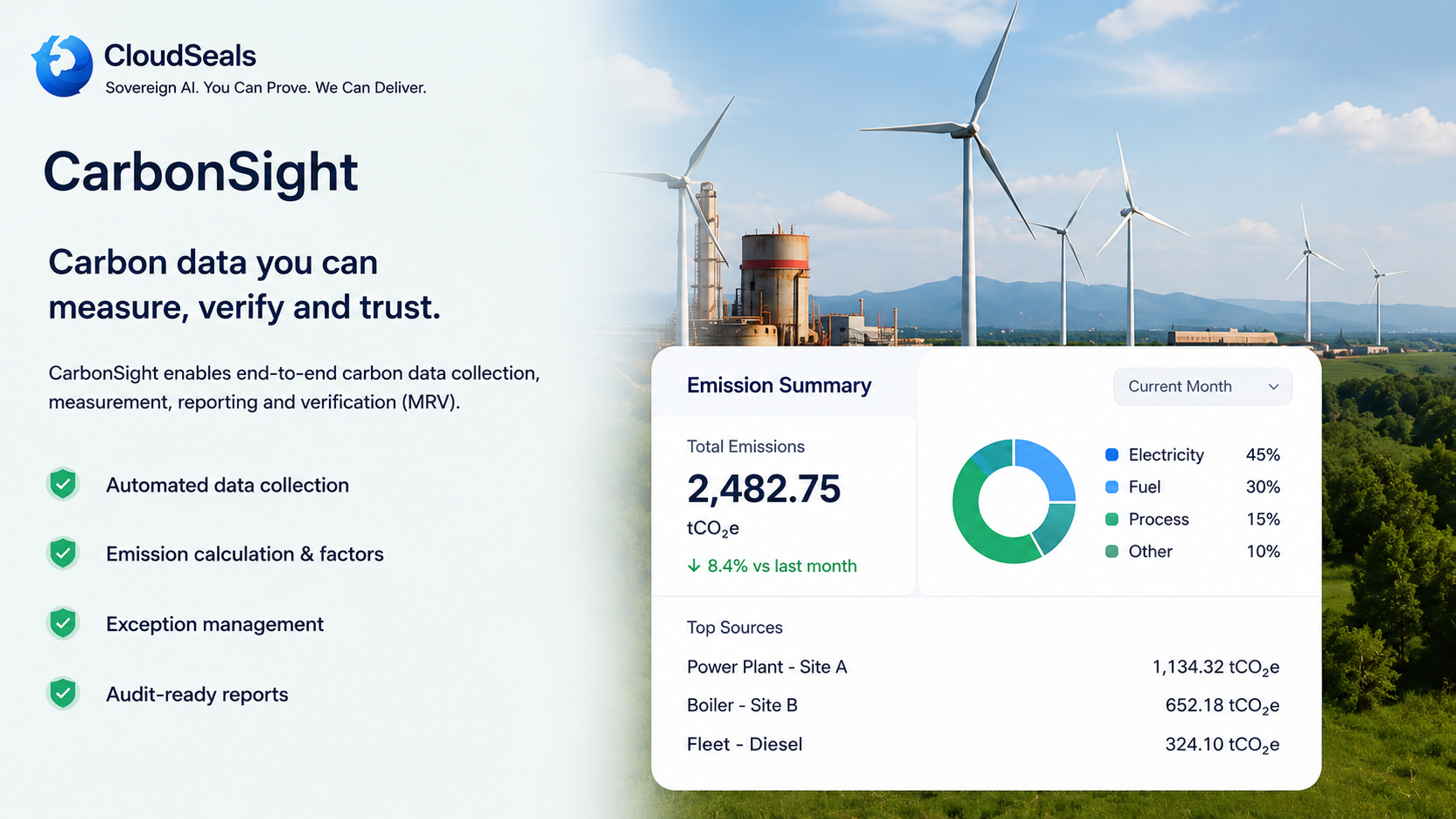
What it helps teams do
Apply approved calculation methods
Review exceptions
Export evidence for assurance/reporting
Who it is for, and how it is deployed
CarbonSight is for the reporting and assurance teams who prepare carbon MRV: the people who own the source data, the approved calculation methods and the review of exceptions before an assurer sees the result. The data sources it reads and the formats it exports for assurance are agreed per deployment and are not listed publicly. The assurance opinion itself always comes from your assurer. CarbonSight is generally available.
How the workflow runs
1. Trace source data
Operational and sustainability data is brought in with its origin kept, so every figure can be traced back to where it came from.
2. Apply the approved method
An approved calculation method is applied to the source data. Method and version are part of the record rather than an assumption.
3. Surface exceptions
Missing or inconsistent source data becomes an exception to review — not a quiet estimate.
4. Review and approve
The reporting team reviews exceptions and approves the figure within the policy boundary; the decision and the reviewer are recorded.
5. Keep the evidence
Source context, method, review, exceptions, approvals and final results are written to Evidence Fabric.
6. Export for assurance
Evidence is exported for assurance and reporting. The assurance opinion is given by your assurer, not by CarbonSight.
How CarbonSight fits
TrustOps is the operating discipline for accountable AI. CarbonSight applies it to carbon measurement, reporting and verification, and Evidence Fabric keeps the record behind each figure — so a number can be traced back to where it came from. Security controls are described on the Security page, what is recorded on the Evidence page, and the overall approach under accountable AI platform.
What CarbonSight does not do
Carbon reporting is reviewed by people who are paid to be sceptical. The boundaries matter.
It does not invent data
Figures trace back to source data and an approved calculation method. Where data is missing, that is an exception, not an estimate.
It does not certify you
It organises evidence for assurance and reporting. The assurance opinion belongs to your assurer.
It does not assume every company is in scope
It is positioned around verification and assurance, not a claim that every company is compelled by CSRD.
Questions we get asked
What is CarbonSight?
CarbonSight organises operational and sustainability data into a traceable MRV workflow: source data, calculation, methodology, review, exceptions and evidence.
What does MRV mean?
Measurement, reporting and verification — the chain from raw operational data through an agreed calculation method to a figure someone else can check.
Can CarbonSight be used for Scope 3?
It is built around traceability of source data, method and review, which is where Scope 3 reporting usually comes under pressure. What is in scope for your organisation is a conversation with your reporting and assurance teams.
Does using CarbonSight mean our figures are assured?
No. It is positioned around verification and assurance — organising the evidence so a review can happen. The assurance opinion itself comes from your assurer.
What happens when source data is missing?
It surfaces as an exception to be reviewed, rather than being quietly filled in.
How does CarbonSight relate to TrustOps and Evidence Fabric?
TrustOps is the operating discipline; CarbonSight is one of the CloudSeals applications that implements it; Evidence Fabric is the shared evidence layer that holds the record.