Configured detection
Use agreed safety rules and camera context to identify review-worthy events.

CompliSight analyses approved CCTV feeds for configured PPE and site-safety rules, sends actionable alerts and keeps evidence of detection, review and closure. It is designed to strengthen supervision and audit evidence—not to infer worker emotions or replace safety management.
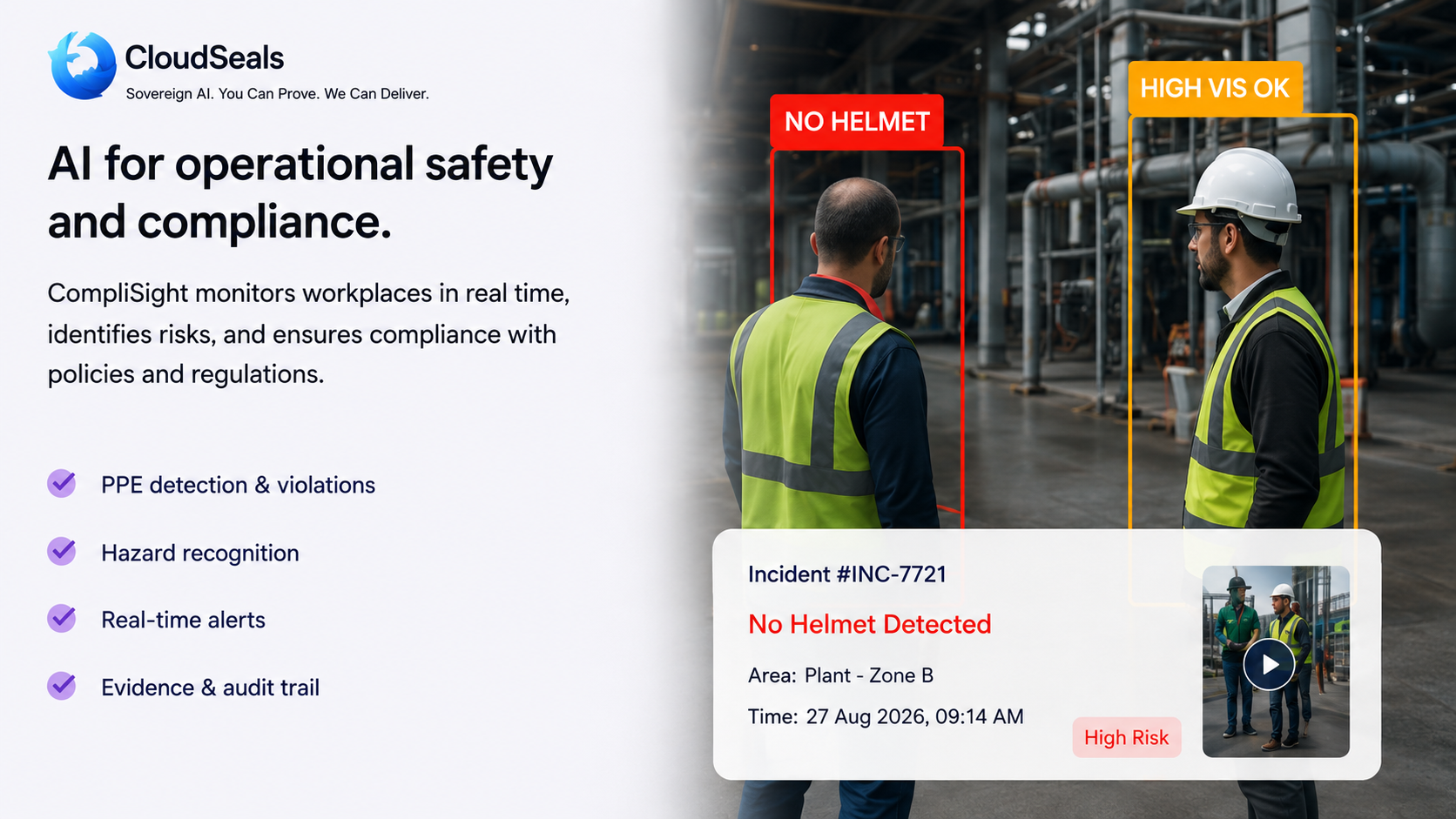
Use agreed safety rules and camera context to identify review-worthy events.
Give supervisors context before an incident is confirmed or closed.
Retain the visual context, status, reviewer and follow-up action for auditability.
The EU AI Act uses a risk-based approach. Classification depends on the specific use case. CloudSeals designs CompliSight around narrow safety rules, privacy controls, human review and evidence; customers remain responsible for assessing their deployment against applicable legal, privacy and worker-representation requirements.
CompliSight is for site-safety and operations teams in industrial environments: the supervisors who review and close an alert, and the auditors who later need the record of what was seen and decided. It analyses approved CCTV feeds already in place and does not need new cameras. Which feeds, which rules and how long evidence is retained are agreed per deployment and are not listed publicly. CompliSight is generally available.
It analyses the CCTV feeds you have approved for it, already in place. Camera and video-management compatibility is confirmed during scoping and is not listed publicly.
Detection is limited to the PPE and site-safety rules that were configured. No inference about how a worker feels or intends.
Supervisors confirm or close an incident; the review is part of the record, and reporting draws on that record.
How long visual context and records are kept is configured per deployment. Customers remain responsible for assessing legal, privacy and worker-representation requirements for their site.
TrustOps is the operating discipline for accountable AI. CompliSight applies it to site safety, and Evidence Fabric holds the record behind each detection and its review. The discipline sets how a decision gets made, the application does the work, and the evidence layer keeps what happened. Security controls are described on the Security page, what is recorded on the Evidence page, and the overall approach under accountable AI platform.
Being clear about the boundary matters more in safety than anywhere else.
Detection is limited to the configured PPE and site-safety rules. It makes no inference about how a worker feels or intends.
It strengthens supervision and audit evidence. Responsibility for safety stays with the people who hold it.
An alert is reviewed and closed by a person, and that review is part of the record.
It analyses approved CCTV feeds already in place.
CompliSight analyses approved CCTV feeds for configured PPE and site-safety rules, sends actionable alerts and keeps evidence of detection, review and closure.
It detects the configured PPE and site-safety conditions it has been set up to look for. It is designed to strengthen supervision and audit evidence, not to infer worker emotions or replace safety management.
A person reviews the alert and closes it. Detection, review and closure are all kept as evidence, so an auditor can see what was seen, who looked at it and what was decided.
Workplace AI carries obligations around transparency, human oversight and record-keeping. CompliSight is built around configured rules, human review and retained evidence. See the EU AI Act guidance page for how CloudSeals approaches these obligations.
No. CompliSight works from approved CCTV feeds that are already in place.
TrustOps is the operating discipline; CompliSight is one of the CloudSeals applications that implements it; Evidence Fabric is the shared evidence layer that holds the record.