
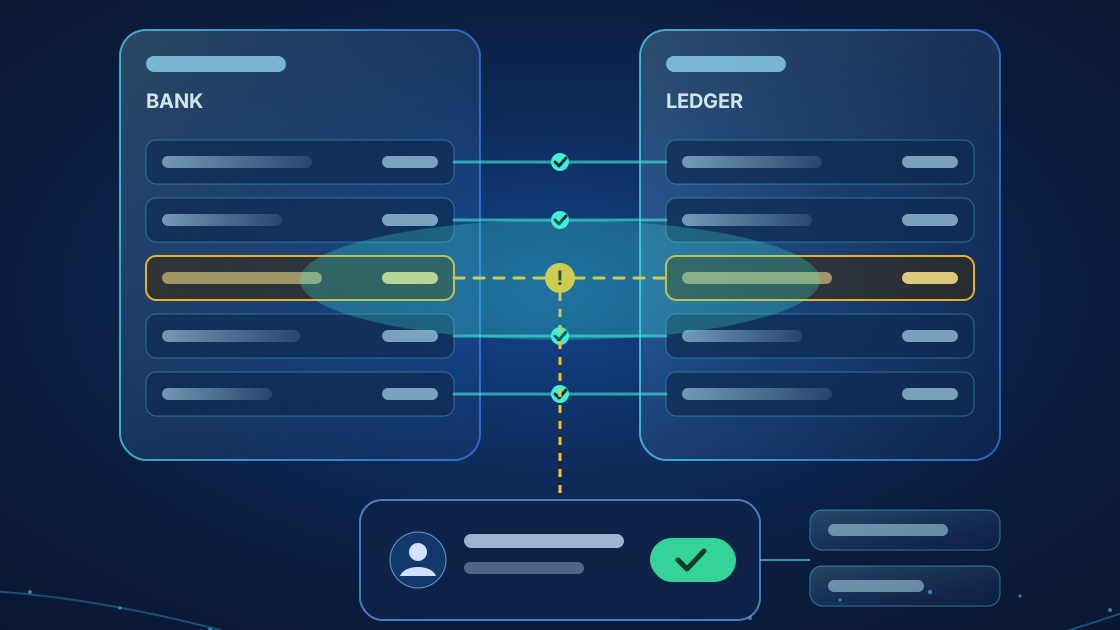
Breaks found late
Statement lines and ledger entries disagree, and the difference is discovered at month end.
Reconciliation and exception review for finance teams and accounting firms. LedgerSight matches bank, receivables and payables data, proposes the next step and keeps the reasoning, the approver and the outcome together, so your close can be explained.
Illustration. Input formats, connected systems and approval routing are confirmed during scoping.
Exceptions with contextTiming differences, duplicates and missing references arrive with the lines that explain them.
A person decidesLedgerSight recommends. It does not post entries or make payments on its own.
A record you can inspectSource, proposal, policy, approver and outcome kept in Evidence Fabric.
Breaks surface late, cash sits unapplied and, at close, nobody can say why an exception was handled the way it was.
More automation should not turn finance control into a black box. The useful part is a reviewable chain from the source line to the person who approved the resolution.
Statement lines and ledger entries disagree, and the difference is discovered at month end.
Short payments and receipts without references are found after the fact.
Supplier invoices are paid against the wrong order or a receipt that does not agree.
The resolution is in the ledger, but the reason and the approver are not.
LedgerSight is generally available. It works with the finance and operational systems already in use, on the exception and approval workflow around them.
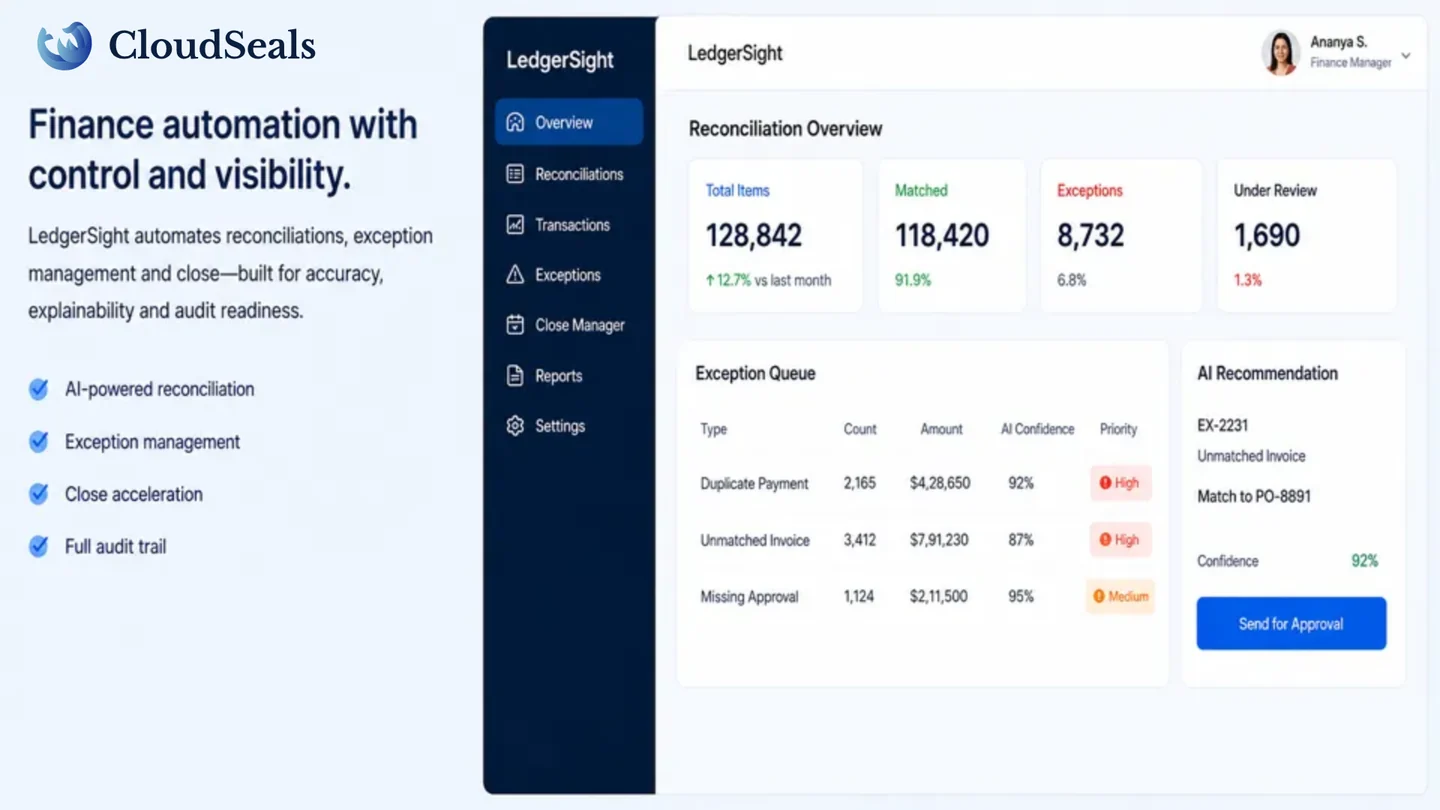
Matches bank, AR and AP data, flags exceptions and records who approved each proposed resolution.
Your accounting system or ERP remains the system of record. Connected systems are confirmed in scoping.
The policy boundary before action and the retained record afterwards, not separate products.
Each workflow needs different source context. Choose one to begin; the others use the same review and evidence pattern.
Statement lines are matched against ledger entries, so timing differences, duplicates and missing references are what a person actually looks at.
Incoming payments are proposed against the right invoices, and the proposal is reviewable before anything is applied. Overdue accounts are ordered by what is worth chasing first, with the reasoning shown alongside.
Supplier invoices that do not agree with the purchase order or goods receipt are routed for review with the context that explains why they were flagged.
Recurring close checks are gathered in one place, so reviewers see status, open exceptions and the evidence that exists for each. Repeated breaks are surfaced so they stop arriving every month unexplained.
Six steps, with the TrustOps boundary applied before any business action and a person at the decision point.
Bank lines, ledger entries, receipts, invoices, purchase orders and goods receipts.
What does not agree becomes an exception, with the context that explains why it was flagged.
Each exception gets a proposal, with the reasoning and evidence shown alongside it.
The applicable rule, procedure or approval threshold is checked before any action.
TrustOps: policy before action.
A reviewer with authority approves, rejects or overrides the proposal.
TrustOps: named authority, no self-approval.
Source, proposal, policy, approval and outcome are written to Evidence Fabric.
Evidence Fabric: the retained record.
A synthetic bank reconciliation case. LedgerSight isolates the difference and proposes a cause; the policy decides who may resolve it.
Unexplained difference£360.00
Illustrative values. A difference divisible by nine often points to transposed digits; the reviewer confirms against the source document.
Statement line, ledger entry and the difference stay attached to the exception.
The exception goes to the named reviewer for the entity and period.
An agent cannot post a correcting entry or approve its own proposal.
Source lines, proposal, rule version, reviewer, decision and outcome.
Own the reconciliations and need every cleared difference to have a reason and an approver.
Work the exception queue day to day and want context with each line, not another spreadsheet.
Run the same workflow on client files, with preparer and reviewer sign-off and an audit workbook or evidence export per client.
Lending business? See LedgerSight for lending.
Every consequential finance action passes through the boundary your team agrees. These are example policies for a reconciliation engagement, not a deployed rulebook.
A reviewer inspects exceptions for the entities and periods they are permitted to access. Access is recorded.
A difference above the agreed tolerance goes to the named approver with the source lines attached.
Self-approval and unapproved journals or payments are refused under the defined policy.
Evidence fields, exports and retention are agreed for each deployment. How TrustOps works · Evidence Fabric · Finance exception review checklist
Start with one reconciliation workflow and a representative dataset. Timing, inputs, delivery format and success criteria are confirmed during scoping; pricing is discussed privately.
Choose the workflow, sample or redacted inputs, the reviewers and the acceptance criteria.
Evaluate exception quality, the approval steps and the usefulness of the evidence with your team.
Check the acceptance criteria and whether a wider deployment fits.
A pilot enquiry does not commit you to a contract.
Start where unexplained differences cost your team the most time at month end. For many teams that is bank reconciliation; the choice is agreed during scoping with a representative dataset.
Approval routing is agreed with you during scoping, so thresholds and approvers reflect how your team already signs off. Preparer and approver stay separate.
Recurring close checks are gathered in one place, so reviewers see status, open exceptions and the evidence that exists for each before the books are closed.
The process owner, the people who review exceptions and the people who approve resolutions. IT and security join for the security review before deployment.
Yes, as a scoped starting point. A pilot uses one workflow and a few representative clients, with your preparers and reviewers, and ends with an audit workbook or evidence export in an agreed format.
No. Start with sample or redacted inputs. Do not send financial records through the website enquiry form.
LedgerSight product overview · Security review · Evidence standards · Workflow examples
Tell us the workflow, the systems involved and who approves resolutions. We will discuss inputs, review points and the evidence your team needs.