
Understand the sources
Identify data owners, formats, refresh cycles, sensitive fields and the systems that remain the source of record. Confirm access and permitted uses before connecting them.
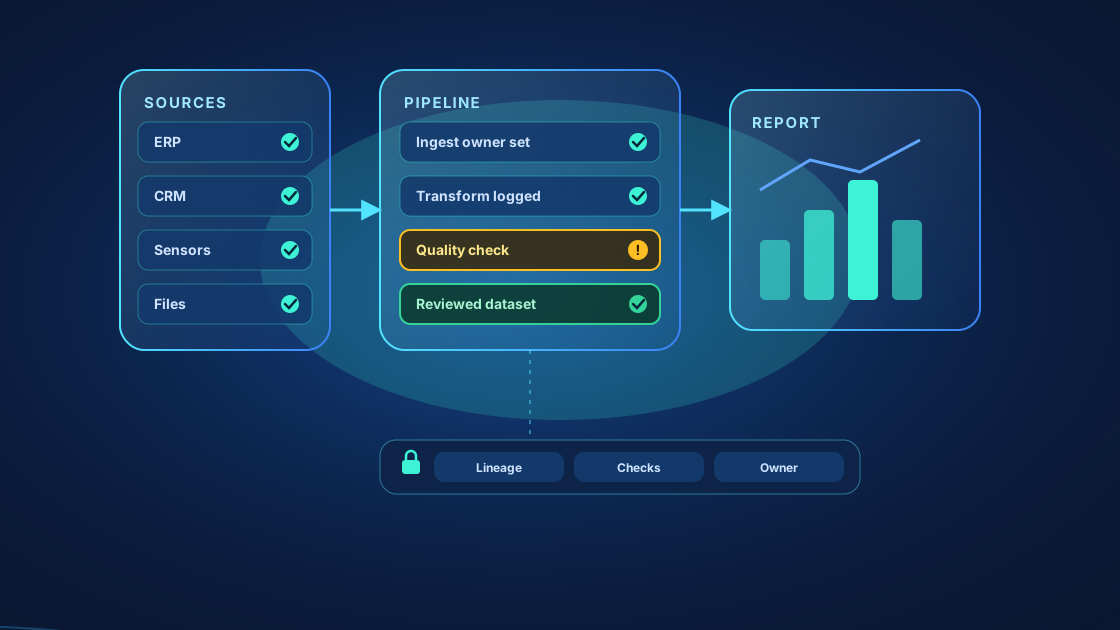
Discuss how source data becomes a reviewed dataset, useful report or application input. Keep ownership, transformations, quality checks and access boundaries visible.
Identify data owners, formats, refresh cycles, sensitive fields and the systems that remain the source of record. Confirm access and permitted uses before connecting them.
Specify the mappings, calculations and quality checks required for the intended output. Record how missing, inconsistent or late data should be handled.
Agree the questions a report or dashboard should answer and who needs to review it. Distinguish measured values, estimates and illustrative examples.
Define refresh ownership, failure reporting, change review, retention and handover. Keep the path from an output back to its sources understandable.
A source inventory, data-flow design, agreed transformations and checks, scoped reporting outputs and operating documentation are deliverables to discuss. Source access and refresh commitments are confirmed per engagement.
Bring your current systems, the problem to solve and the people who will review the result. The team will confirm fit, dependencies and scope before committing to delivery.
These are engineering services, separate from the CloudSeals applications. For finance reconciliation see LedgerSight; for configured safety events see CompliSight; for carbon evidence see CarbonSight.
See the wider AI Cloud Engineering service for implementation and deployment support.